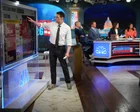
Tuesday's midterm coverage will be remembered as a watershed moment, according to Rashida Jones, chief executive of Piers Morgan's media company Uncensored. She calls it "the content creator election" – a phrase that should concern every executive suite at ABC News, CNN, and NBC News. The old model of assuming viewers will tune in because there's a guy at a board and a ticker at the bottom is no longer valid. Jones, who ran MSNBC for four years before joining Morgan's operation, is not exaggerating the threat.
The competition is real and credible. Jim Acosta, who spent nearly 18 years at CNN before leaving last year, will host a live broadcast from the University of Virginia on YouTube and Substack alongside Katie Couric, the former Today show co-host. Scott MacFarlane, a veteran CBS News reporter who left in March seeking independence, now co-hosts MeidasTouch's election broadcast. These are not fringe operators – they are seasoned journalists taking their credibility and audiences elsewhere. MacFarlane's promise of "no teleprompters and no scripts" and "direct, conversational" coverage "heavy on original reporting" should read as a direct critique of traditional television's formulaic approach.
Yet the networks are not standing still. NBC News has marshaled Hallie Jackson, Savannah Guthrie, Tom Llamas, and Kristen Welker for extended coverage, with Jackson scheduled for nine hours. CNN's David Chalian highlighted CNN Sightline, a new transparency tool, and emphasized that the decision desk operates with "at least 99.5% confidence" before calling races – a standard driven by concerns over voter confidence in elections. ABC News plans a seven-hour broadcast and emphasized it reaches "the audience where they are" across television, Hulu, Disney+, and ABC News Live.
But Jackson's revelation about election night preparation – staying hydrated, healthy eating, and "a secret pack of M&Ms for your blood sugar that you can come back to every hour" – inadvertently highlights what audiences are rejecting: the theatrical pageantry of traditional election coverage. Meanwhile, Piers Morgan's Uncensored has 4.5 million YouTube subscribers, demonstrating that audiences exist for independent voices doing the work without the production apparatus.
The networks should interpret Jones's prediction seriously. She is right that traditional television cannot assume loyalty. The question for November is whether networks can prove they offer genuine value beyond production budgets and established names. If they cannot convince viewers that their depth, scope, and breadth matter more than authenticity and independence, the "content creator election" may become permanent reality.